They called it Kaal Jheel, though no map ever kept the name for long.
The lake lay beyond the last millet field, past the bent peepal tree where crows refused to nest.
Villagers said the water remembered every face that looked into it.
On still mornings the surface stayed dark, even under direct sun.
No ripples moved unless someone spoke aloud.
Silence kept the lake calm.
Words disturbed it.
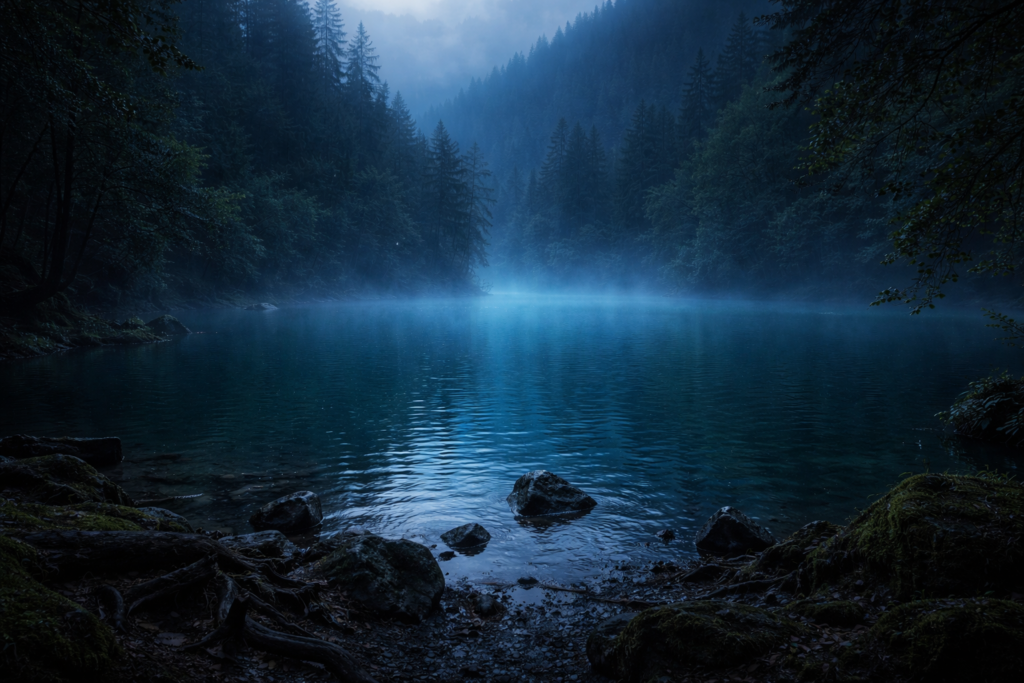
Children were warned not to count the stones along its edge.
If they reached the same number twice, the lake would notice.
Old women tied red thread around their ankles when passing nearby.
They claimed the water listened for footsteps.
Men avoided fishing there after dusk.
Fish pulled from Kaal Jheel were always heavier than expected.
Some bled before they were cut.
The first disappearance no one spoke of happened before anyone remembered.
The second had a name but no body.
By the third, the village learned restraint.
Stories were shortened.
Memories were trimmed.
Truth was folded small enough to hide in the mouth.
I arrived during the season when fog crawled out of the water at dawn.
It wrapped the fields like damp cloth.
The villagers watched me from doorways.
They watched my reflection more than my face.
A woman spat to the side when she saw my shadow touch the lake path.
An old man muttered a prayer that did not belong to any god.
The lake smelled of iron and wet leaves.
It was not large.
It felt deep.
The air above it pressed against my ears.
My thoughts slowed when I stood too close.
I forgot why I had come there.
The forgetting felt intentional.
At the shore, reeds bent inward as if listening.
I heard something beneath the surface.
It was not movement.
It was waiting.
The water reflected the sky incorrectly.
Clouds appeared stretched and thin.
My face looked older than it should.
A local boy named Arun followed me that day.
He would not step closer than ten paces from the edge.
He said the lake took people who stared too long.
He said it learned their voices first.
When I asked how he knew, he closed his mouth tightly.
His eyes filled instead.
At night, the village drums played without hands.
No one admitted hearing them.
Dogs refused to bark.
The lake shone faintly, like breath on glass.
I dreamed of water climbing stairs.
I dreamed of my name spoken backwards.
In the morning, footprints circled the lake.
They did not lead away.
They ended at the edge, neat and patient.
No one investigated.
No one asked who they belonged to.
Breakfast was eaten quietly.
An elder finally spoke to me after three days.
She said the lake was older than the village.
She said it fed on attention.
She said forgetting was a form of protection.
Her voice trembled when she said my name.
She asked how long I planned to stay.
That evening, I heard splashing where there should have been none.
The water moved as if breathing.
Something rose and then settled again.
My reflection did not copy me.
It smiled late.
I understood then why stories here ended early.
I understood why names were swallowed mid-sentence.
The lake was listening.
And I had already told it too much.